Elaine Chapman is the Lead Advisory Nurse for Cambridge Cancer Research Hospital, the new specialist cancer research hospital for the East of England. Her role has been largely focussed on working to develop the hospital’s designs, and now she’s leading on establishing new models of care in the planned facility, to improve the experience for future patients and staff.
Image: Still Vision. Watch Elaine's story
Link: https://www.youtube.com/watch?v=cs2_Wys9E9M
“I see my role almost like a bridge between our patients and clinical teams, the design teams, and architects, to translate how we will deliver cancer services in the building, and how we will deliver care, as we combine research and clinical practice into one building.”
Elaine
Elaine has had a long career working in cancer and in 2006, she was diagnosed with stage 4 metastatic breast cancer when she was just 31 years old. Despite being told she had five years to live, Elaine has been living with cancer for almost 20 years.
“I have just been so lucky. Each time my cancer has progressed, there’s been a new ‘lily pad’, where I’ve been able to jump from one older treatment to the next, and this is because of research. Advances in research have always provided me with a new drug or treatment, so I have been able to continue to live a full and active life.”
Elaine began her cancer career working as an oncology nurse at Cambridge University Hospitals (CUH) in 2000, where she gained skills in giving chemotherapy.
She then progressed across a number of roles at Addenbrooke’s and was appointed the hospital’s Lead Cancer Nurse in 2014, before taking on her current position as Lead Advisory Nurse for Cambridge Cancer Research Hospital.
Since her diagnosis, Elaine has signed up to several research studies and has greatly benefited from maintenance research programmes at Addenbrooke’s Hospital, which has enabled her to live a happy life.
“Without research, I strongly suspect I would not be here today. I have been able to continue living a full and active life as a person and a nurse at Addenbrooke’s. It’s amazing to think that this kind of rapid excellence will soon become the norm within our clinical spaces too.”
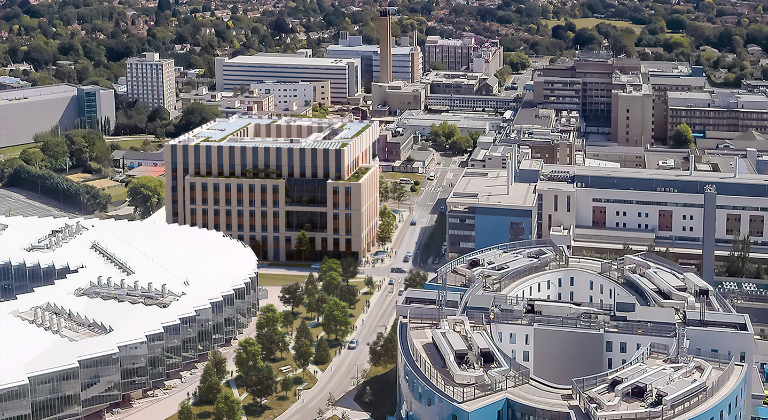
Cambridge Cancer Research Hospital will house a unique community of scientists and clinicians under one roof, bringing clinical expertise from Addenbrooke’s Hospital and world-leading researchers from the University of Cambridge together. This will accelerate research into clinical care, enabling NHS staff to detect cancer earlier, treat it more precisely and bring more life-saving therapies to patients across the UK faster than ever before.
By treating the disease at a much earlier stage, patients will spend less time in hospital, have more one-off treatments - rather than invasive procedures - and this will help to improve cancer waiting times and a patient’s quality of life.
“I was diagnosed at a really young age, it was just devastating. You just feel like your whole world stops.”
For Elaine, she was initially treated with radiotherapy on her spine because her breast cancer had spread to her bones. She had cycles of anti-cancer chemotherapy treatment, which was combining chemotherapy with the drug Herceptin, as her cancer is hormone-driven (HER2 positive). Elaine then needed a mastectomy, more chemotherapy, surgery and radiotherapy.
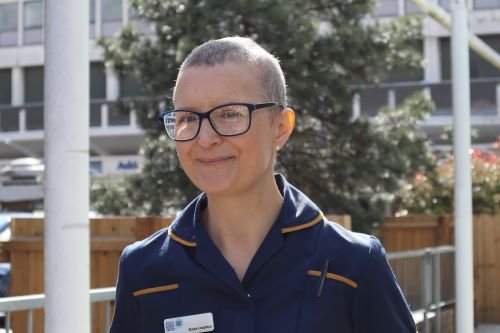
In 2016 it was discovered that Elaine’s breast cancer had spread to her brain, after a metastatic brain tumour was found. Fortunately, over the past decade, she’s been able to keep her cancer stable.
Elaine said: “My treatment is going really well. I’m able to work virtually full-time and live a full and active social life.
"As someone living with cancer, I am often asked: ‘What motivates me to work in cancer?’ For me, working and being treated at Addenbrooke’s feels a lot like home. I feel much more motivated now because of what the potential Cambridge Cancer Research Hospital is going to offer us, and that fills me with a lot of hope and joy.”

Elaine said “one of the most enjoyable parts” of her role is working with the project’s Patient Advisory Group (PAG), set up from the Cancer Patient Partnership Group (CPPG) at Addenbrooke’s Hospital.
The working group of patients and carers with lived experience of cancer are co-producing the hospital, offering unique ideas and feedback on how it should be designed, built and run.
“Patients see things that staff just don’t see,” said Elaine.
“Hearing from people who have gone through, or are currently having cancer treatment, is so important, as the lived experience is often very different from professionals.
“We’re working together on all sorts of things, including looking at how patients will navigate through the building and how might wayfinding apps work? And how can well-designed green spaces support patients’ wellbeing?”
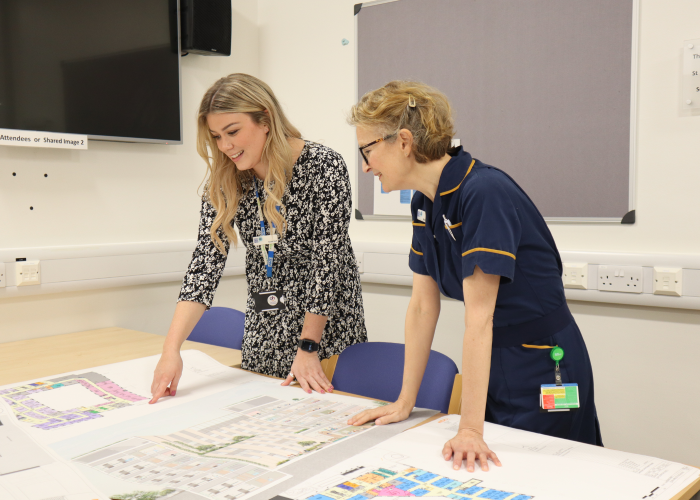
Now the physical design of Cambridge Cancer Hospital is largely complete, Elaine’s recent work has been focussed on how services will be delivered in the future building, developing new models of care known as Target Operating Models (TOMs). This involves working with the clinical teams at Addenbrooke’s on how to improve the current experiences of patients and staff. The team are, for example, exploring how to use digital technology and AI to be more efficient and improve the flow of cancer patients in the new building. Elaine and her team are also exploring how to work more effectively with University of Cambridge researchers, to ensure patients can benefit from the latest innovations in cancer science, both now and in the new Cambridge Cancer Research Hospital.
“We’re determining what efficiencies we will gain from our cancer teams moving into one space and looking at the kind of culture we will need for Cambridge Cancer Research Hospital to thrive,” said Elaine.
“Working on this project is a total privilege. It really is so exciting to bring researchers and clinicians together and to bring science from the bench to the bedside to our patients.”
Elaine